Eight user roles with different permissions and responsibilities.

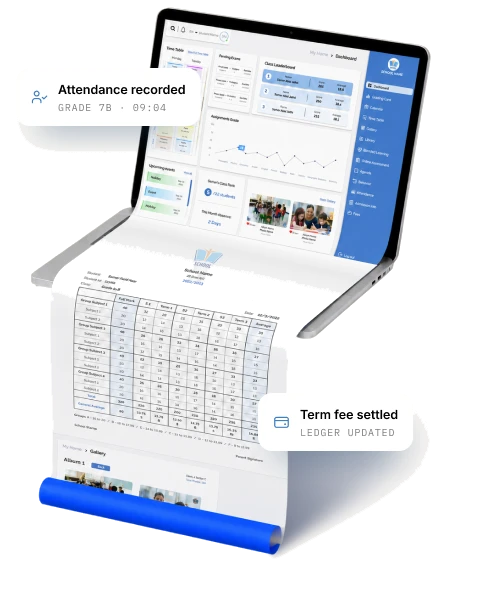
Massarat, meaning “My Learning Pathways,” is a multi-role School Information System designed and developed by Nexus to manage the full school journey—from admission and registration to academics, HR, finance, and daily operations. Nexus translated the complexity of school management into a centralized student management system built around how each stakeholder actually works.

Industry
Education / School Management

Platform
School Information System (SIS)

Users
Administrators, teachers, students, parents, accountants, HR teams and psychologists


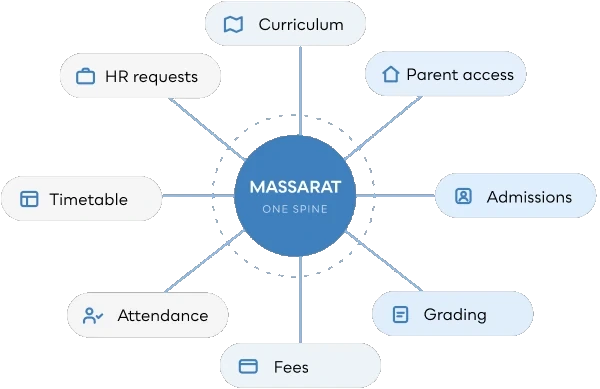
Admissions, grading, payments, timetables, HR requests, attendance, curriculum, and parent access are often managed through separate tools and manual coordination.
This creates duplicated work, fragmented data, slower decisions, and limited visibility across departments.
Massarat needed to support four non-negotiables
Eight user roles with different permissions and responsibilities.

The full journey from application to enrollment and academic progress.

Flexible grading across years, classes, subjects, exams, terms, and rules.

Academic, administrative, HR, and financial workflows within one platform.
The challenge was not to add more screens.
It was to turn the school’s operating logic into a system people could use every day.
Nexus approached Massarat as a full education digital transformation project.

01
We structured the platform around different user roles, including Super Admin, Admin, Teacher, Student, Parent, Accountant, Human Resources, and Psychologist.

02
We designed the system around real school workflows, from admissions and registration to grading, attendance, HR, payments, timetables, and academic planning.

03
We divided the platform into clear modules so every department could manage its own work while staying connected to the wider system.

04
We built advanced grading and academic configuration logic that supports academic years, groups, classes, sections, subjects, exams, terms, mark types, passing marks, weights, objectives, competencies, and calculation rules.

05
We developed settings and control modules that allow the school to manage roles, accounting, payroll, leave settings, extracurricular settings, additional fields, school details, and system details.

06
We implemented modules that support the daily rhythm of school life, including calendar, timetable, attendance, behavior, agenda, lesson planning, and online assessment.
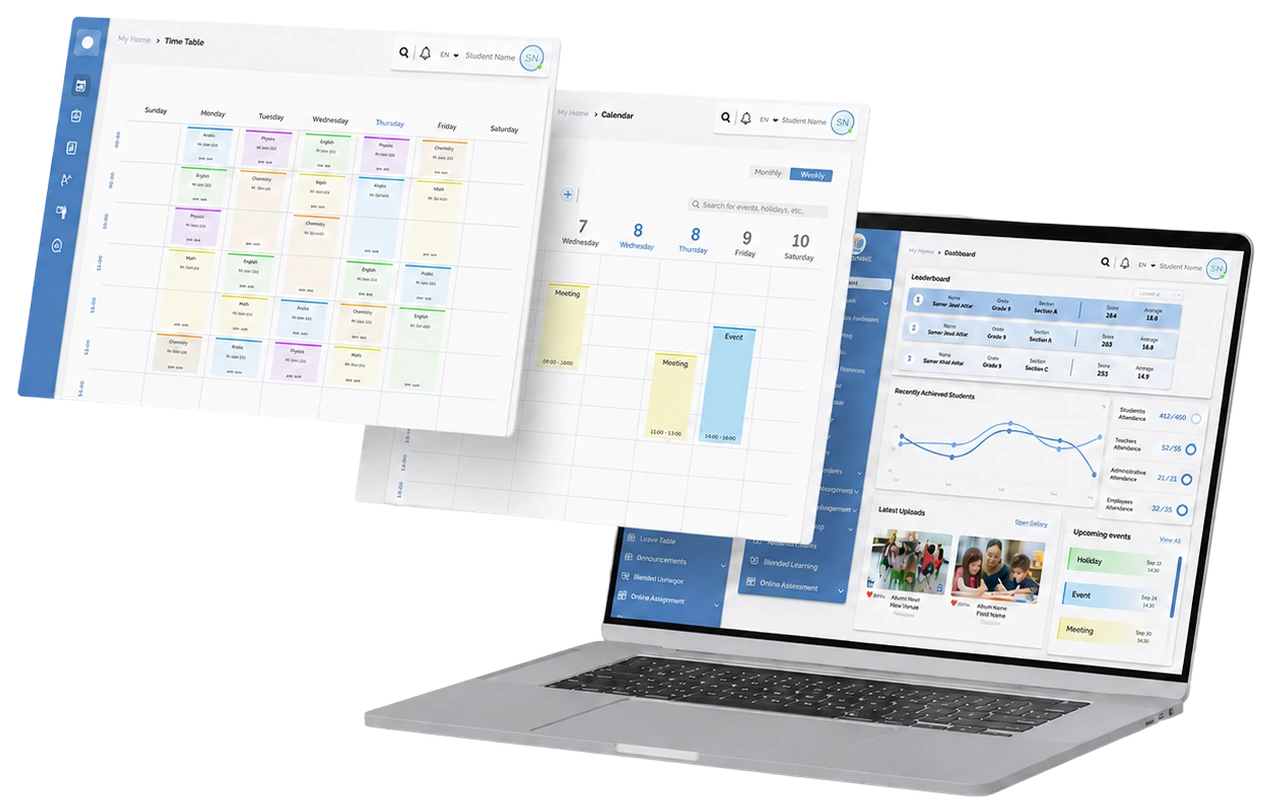
Nexus designed and developed Massarat as a broad multi-module School Information System.
Each module was built to support a specific part of school operations
while remaining connected to the overall platform structure.
Massarat gave schools one centralized system to manage academic, administrative, HR, financial, and student-related workflows.
Massarat brings the school’s core administrative functions into the same environment:
Employee profiles, contracts, teaching assignments, salary grades, bank details, leave requests, and supporting documents.
Calendars, events, meetings, holidays, class and teacher timetables, attendance, agendas, and behavior tracking.
Fees, payments, payroll settings, discounts, student financial records, and accounting controls.
Book search, availability, reservations, browsing, and detailed records. The school gains clearer oversight while teams spend less time coordinating information manually.
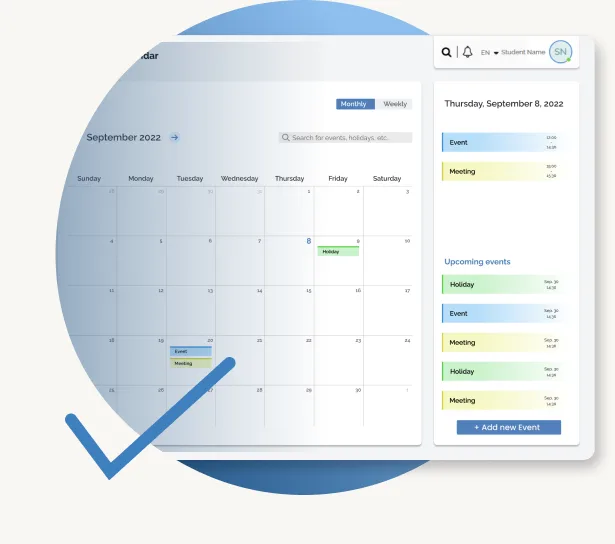
Academic teams can manage lesson planning, curriculum mapping, question banks, blended learning, and online assessments alongside student and grading data.
A centralized settings layer gives administrators control over roles, accounting, payroll, leave policies, extracurricular settings, custom fields, school details, system information, and access permissions.
This balance makes Massarat flexible enough for different school structures without sacrificing consistency or governance.
From Fragmented Operations to Institutional Clarity. Massarat gave the school:

One reliable source of operational and academic information

Tailored dashboards and permissions for eight user roles

Structured student, employee, financial and academic workflows

Less dependence on scattered tools and manual coordination

A digital foundation that can evolve with the institution
Nexus did not simply digitize existing tasks. We designed the infrastructure needed to manage the institution as one coordinated operation.

Now It Needs the Infrastructure to Bring Them Together. Nexus maps how your institution operates, identifies the gaps slowing it down, and defines the system required to improve clarity, coordination, and capacity.
Book Your Education Systems AuditA focused working session to identify operational gaps, prioritize the workflows that matter most, and define the digital infrastructure your institution needs to scale.